Conveyor Belt Scales and Weighing Solutions for Bulk Material Handling
Conveyor belt scales help industrial operations measure bulk material continuously while it moves, giving teams reliable data for production reporting, inventory control, compliance, and process optimization. The right weighing solution can reduce guesswork, improve flow-rate visibility, and support better decisions across mining, aggregate, cement, agriculture, recycling, and other heavy-duty applications.
This guide focuses on the conveyor belt scale design details that matter most: weighbridge configuration, calibration methods, accuracy expectations, environmental durability, and digital integration. It also explains how to evaluate a conveyor belt scale manufacturer when product quality, support, and long-term performance are part of the decision.

At their core, conveyor belt scales do one job: weigh bulk material continuously while it moves. They combine load cells, a weighbridge, and a speed sensor to calculate real-time flow rates and totalized weights — without ever stopping the belt.
But not all belt scales are built the same. Accuracy, durability, configuration, calibration requirements, and digital features vary enormously from one system to the next.
Selecting a Conveyor Belt Scale Manufacturer: Technology and Design Factors
Selecting the right industrial weighing solution is more than just choosing the lowest price tag. It requires looking closely at how a system is designed, built, calibrated, and supported in the field. Heavy-duty material handling is a brutal environment. Constant vibration, dust, moisture, and temperature fluctuations will quickly expose shortcuts in scale design or manufacturing quality.
When evaluating conveyor belt scales, start with the core components. High-quality load cells - ideally with built-in overload protection - are the foundation of any accurate system. The speed sensor must be equally robust, providing precise belt travel data even if the belt slips or stretches. The weighbridge should fit the conveyor structure cleanly, isolate live material load from belt tension, and maintain alignment under real production conditions.
What to Look for in a Conveyor Belt Scale Manufacturer
To find a partner that can support your business over the long haul, consider these critical criteria:
- Deep Industry Experience: Look for a manufacturer that has spent decades refining their technology in real-world environments.
- Engineering Capabilities: Can they customize the weighbridge or mounting system to fit your existing conveyor structure without requiring extensive modifications?
- NTEP Certification: If you are selling material directly off the belt, you need a legal-for-trade scale certified by the National Type Evaluation Program (NTEP).
- Global Support Network: When a sensor fails, you cannot afford to wait weeks for a replacement part. A manufacturer with global service support ensures minimal downtime.
For operations requiring rugged, highly adaptable solutions, systems like the Conveyor Belt Scale WM100-BS offer an excellent balance of heavy-duty construction, simple installation, and reliable in-motion weighing performance.
How Conveyor Belt Scales Maintain Calibration and Precision
Precision is not a one-time achievement; it is a continuous requirement. Leading scale systems use several engineering strategies to maintain accuracy over millions of tons of material:
- Multiple Accuracy Classes: Systems are typically categorized into specific accuracy classes (such as Class 0.5, 1, or 2). This allows operations to match the scale's precision to their specific needs - whether that is high-precision custody transfer or general process monitoring.
- Mass-Counterbalanced Designs: By counterbalancing the physical weight of the weighbridge itself, the system only measures the "live load" of the material. This maximizes load cell utilization and dramatically improves the signal-to-noise ratio.
- Physical Test Weights: While some systems rely on electrical simulation (resistor calibration) to test the scale, top-tier manufacturers prefer physical test weights or test chains. Physical weights exercise the scale's mechanical levers, ensuring a highly accurate and verifiable calibration.
- Zero Stability: Advanced electronics automatically track and correct for "zero drift" caused by material buildup on the belt or temperature-induced expansion of the conveyor frame.
Single-Idler, Multi-Idler, and Specialized Scale Configurations
Conveyor systems come in all shapes and sizes, which is why manufacturers offer a variety of weighbridge configurations. Choosing the right physical layout is essential for balancing your budget with your accuracy targets.
Modern Conveyor Belt Scales rely on precise mechanical alignment to isolate the downward force of the material from the horizontal tension of the conveyor belt.

Single-Idler vs. Multi-Idler Weighbridges
The main difference between scale configurations lies in the number of conveyor idlers (rollers) supported by the scale's weighbridge.
- Single-Idler Scales: These systems support a single conveyor idler. They are compact, cost-effective, and easy to install in tight spaces. They are ideal for process control, checking feed rates, or monitoring inventory where an accuracy of ±0.5% to ±1.0% is sufficient.
- Multi-Idler Scales: Supporting anywhere from two to eight idlers, multi-idler scales distribute the material weight over a longer section of the belt, increasing material residence time. This design minimizes the negative effects of belt tension and stiffness, as well as mechanical errors, allowing the system to achieve exceptional accuracy levels of ±0.25% or better. These are the go-to choice for high-speed, high-capacity conveyors and legal-for-trade custody transfer.
| Scale Configuration | Typical Accuracy | Best Applications | Key Advantage |
|---|---|---|---|
| Single-Idler | ±0.5% to ±1.0% | In-process monitoring, blending, low-flow systems | Lower cost, compact footprint, fast installation |
| Multi-Idler (2 to 4 Idlers) | ±0.25% to ±0.5% | Stockpile inventory tracking, production reporting | Excellent stability, handles high belt speeds |
| High-Precision (6 to 8 Idlers) | Up to ±0.125% | Legal-for-trade, custody transfer, rail loadout | Maximum accuracy, NTEP approved |
| Specialized (Catenary/Flat Belt) | ±1.0% to ±2.0% | Mobile crushing, screening, portable conveyors | Highly flexible, tolerates severe vibration |
Specialized Catenary and Flat Belt Scales
Standard conveyor belts sit on troughed idlers (usually angled at 20, 35, or 45 degrees) to cradle bulk materials. However, many mobile processing operations use specialized conveyor designs.
For example, mobile crushers and screening plants often utilize catenary idlers—suspended, flexible rollers that absorb heavy impacts. A specialized weigh belt feeder or catenary belt scale must be engineered to handle these shifting geometries while maintaining reliable weight readings. Similarly, flat-belt conveyors, commonly used in recycling or agricultural packaging, require flat-profile weighbridges designed to prevent material from sliding off the sides of the belt during measurement.
Industrial Applications and Environmental Durability Challenges
Conveyor belt scales are the unsung heroes of heavy industry. From the frozen quarries of northern Canada to the humid agricultural ports of the Gulf Coast, these systems provide the real-time data needed to optimize production, manage stockpiles, and prevent vehicle overloading.

Industry-Specific Challenges in Mining, Cement, and Agriculture
Each sector presents a unique set of challenges that a conveyor scale must overcome:
- Mining and Quarries: High-tonnage operations deal with massive, abrasive rocks that crash onto conveyors, creating severe mechanical shock and vibration. Scale frames must be built with heavy-gauge structural steel to prevent bending under load.
- Cement Plants: Extremely fine, abrasive dust can quickly penetrate standard sensor housings. Cement operations require scales with hermetically sealed load cells and dust-mitigation covers to prevent mechanical binding.
- Agriculture and Fertilizer: Chemical fertilizers are highly corrosive, while agricultural products like grain can create explosive dust environments. Scales in these sectors require specialized material construction and safety certifications.
Engineering for Harsh and Corrosive Environments
To survive these environments, top manufacturers utilize advanced materials and protective designs:
- 316 Stainless Steel: For chemical processing, marine ports, and food-grade applications, 316 stainless steel provides superior resistance to acids, salts, and washdown chemicals compared to carbon steel.
- Hazardous Area Certifications: In environments with explosive dust or gases (such as coal handling or grain terminals), scales must carry ATEX, IECEx, or Class I/II, Div 1/2 certifications to guarantee they will not spark an explosion.
- Washdown Protection: IP69K-rated load cells and junction boxes can withstand high-pressure, high-temperature washdowns without losing their seal.
Digital Monitoring, Cloud Connectivity, and Integration Considerations
In the modern industrial landscape, a scale that only displays weight on a local screen is no longer enough. Today's operations demand connected weighing solutions that feed real-time production data directly into enterprise software.
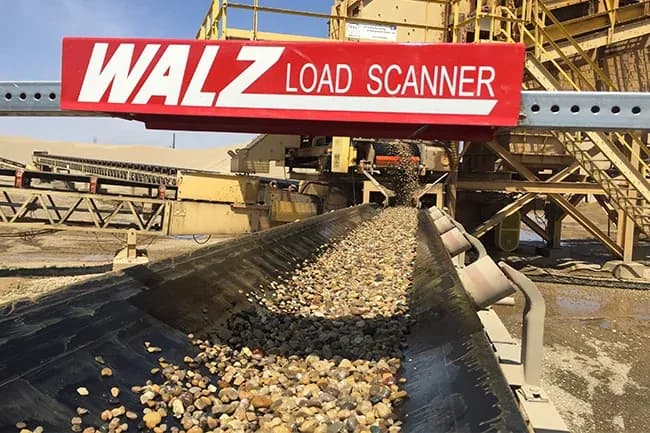
Some operations also benefit from Conveyor Belt Volume Scanning systems, which use lasers to measure material volume in real time. Volume scanning can complement belt scale data by helping teams understand material profile and bulk density, but weight-based conveyor belt scales remain the core solution for mass measurement, production totals, and many trade or reporting applications.
SaaS Platforms and Real-Time Production Intelligence
The latest advancement in conveyor scale technology is the shift toward Software-as-a-Service (SaaS) production intelligence. Modern scale integrators connect directly to local networks or cellular gateways, sending data to secure cloud platforms.
This connectivity allows plant managers, corporate executives, and maintenance teams to monitor operations from anywhere in the world. Real-time dashboards track key performance indicators (KPIs) like Overall Equipment Effectiveness (OEE), cost per ton, and total daily throughput. Furthermore, automated downtime tracking can detect when a belt is running empty or has stopped entirely, sending immediate alerts to maintenance teams to minimize lost production.
Through open APIs, this data integrates seamlessly with existing Enterprise Resource Planning (ERP) systems (like SAP) and computerized maintenance management systems (CMMS), closing the loop between production and business administration.
Installation and Control System Integration
Even the most advanced scale is useless if it cannot communicate with the rest of your plant. When selecting a system, look for low-profile, drop-in designs that slide easily into your existing conveyor frame with minimal cutting or welding.
For local automation, the scale integrator must support common industrial protocols—such as Modbus, EtherNet/IP, or Profibus—to connect directly to your Programmable Logic Controllers (PLCs). This allows the scale to control upstream feeder speeds, manage automated batching gates, or trigger alarm systems if a conveyor experiences an overload condition.
Frequently Asked Questions about Conveyor Scales
What is the difference between a conveyor belt scale and a volumetric load scanner?
While both systems measure material on a moving belt, they use completely different physical principles:
- Conveyor Belt Scales: Measure actual mass (weight) using load cells. This is highly accurate for inventory and trade, but can be affected by belt tension and mechanical friction.
- Volumetric Load Scanners: Use non-contact laser technology to measure the physical volume (cubic yards/meters) of the material profile. This method is completely immune to belt tension issues and can be explored further in Industrial Conveyor Belt Volume Scanning.
By comparing the weight from a scale with the volume from a scanner, operators can calculate the real-time bulk density of their material—a critical metric in mining, concrete, and agricultural processing.
How often do conveyor belt scales need to be calibrated?
The ideal calibration frequency depends on your required accuracy and the severity of your operating environment. For general process monitoring, a monthly zero-balance check and a quarterly span calibration using physical test weights are usually sufficient. For high-accuracy, legal-for-trade custody transfer applications, weekly or even daily zero checks may be required, alongside regular material run tests to verify system repeatability.
Can conveyor scales achieve legal-for-trade accuracy?
Yes. To be used for commercial transactions (where prices are determined by the weight measured on the belt), the conveyor scale must be certified by regulatory bodies like the National Type Evaluation Program (NTEP) in the United States. These systems typically require multi-idler configurations (often 4 to 8 idlers), high-precision speed sensors, and rigorous testing under real-world operating conditions to achieve an accuracy of ±0.10% to ±0.125%.
Conclusion
Whether you are managing a high-output aggregate quarry, a complex chemical plant, or a portable recycling operation, selecting the right conveyor belt scale and weighing solution is the first step toward long-term operational efficiency.
With nearly 60 years of engineering experience, Walz Scale provides heavy-duty, NTEP-certified legal-for-trade scales, advanced volumetric scanners, and global service support tailored to the toughest industrial environments.
Ready to optimize your material handling and protect your bottom line? Explore our full line of industrial weighing systems at Walz Scale Conveyor Belt Scales and find the perfect fit for your operation today.