Why Choosing the Right Floor Scales Online Can Make or Break Your Operation
Shopping for floor scales online is faster and easier than ever — but only if you know what to look for before you buy.
Here's a quick overview of what matters most:
| Factor | What to Look For |
|---|---|
| Capacity | 500 lb up to 20,000 lb depending on application |
| Platform Size | 2'x2' up to 7'x7' (or larger for special applications) |
| Material | Mild steel for dry environments; stainless steel for washdown |
| Certification | NTEP Class III for any commercial or legal-for-trade use |
| Accessories | Ramps, printers, pit frames, remote displays |
| Warranty | Look for 5-year platform coverage as a baseline |
For operations managers in mining, agriculture, construction, or waste management, a wrong purchase means downtime, compliance failures, and inaccurate payload data — all of which cost real money.
The good news? The right industrial floor scale is available online with the specs, certifications, and support you need. But there are real differences between models — in materials, load cell quality, NTEP approval status, and after-sale service — that aren't always obvious from a product listing alone.
This guide cuts through the noise so you can make a confident, informed decision.

Key Types and Materials of Floor Scales Online
When browsing for floor scales online, the sheer volume of choices can feel overwhelming. However, industrial weighing systems generally fall into distinct categories based on their design, construction materials, and intended applications. Understanding these differences is the first step toward choosing a system that will survive your facility’s daily grind.
At their core, industrial floor scales are designed to sit directly on the ground, handling everything from standard pallets and heavy drums to bulk agricultural yields. For most industrial facilities, the choice comes down to finding a balance between weight capacity, structural footprint, and the environmental conditions the scale must endure. To explore these configurations in depth, you can browse a wide selection of Industrial Floor & Pallet Scales.
To help you visualize the primary differences, here is a quick comparison of the two dominant materials used in heavy-duty scale manufacturing:
| Feature | Mild Steel Floor Scales | Stainless Steel Floor Scales |
|---|---|---|
| Primary Environments | Dry warehouses, shipping docks, general manufacturing | Food processing, chemical plants, sanitary washdown areas |
| Corrosion Resistance | Moderate (typically powder-coated or painted) | High (highly resistant to water, acids, and harsh chemicals) |
| Relative Cost | Highly budget-friendly | Higher initial investment |
| Typical Load Cells | Alloy steel shear beam load cells | Stainless steel, hermetically sealed (IP69K) |
| Cleaning Method | Dry sweeping, light wiping | High-pressure water, sanitizing chemicals |
Selecting the Right Platform Size and Capacity
Matching your physical space and maximum load requirements to the right scale dimensions is critical. In the online marketplace, platform sizes typically range from compact 2' x 2' footprints up to expansive 7' x 7' or even 12' x 10' custom configurations.
For the vast majority of warehouse operations, the standard 4' x 4'< and 5' x 5' platforms are the go-to choices. A 4' x 4' platform is perfectly sized for weighing standard wooden shipping pallets, while a 5' x 5' platform provides a bit of extra wiggle room for forklift operators or oversized loads.
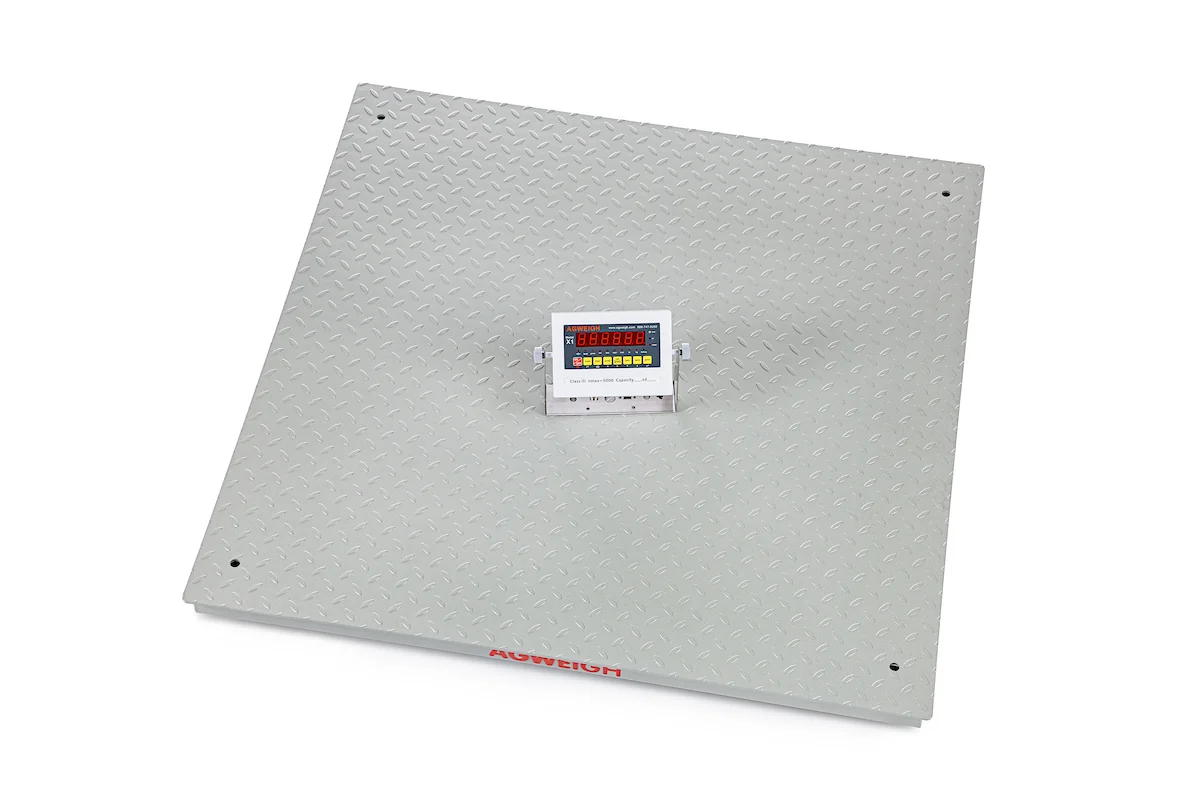
Capacity ranges are equally diverse, commonly spanning from 500 pounds to 20,000 pounds. A 5,000-pound capacity scale handles typical palletized freight with ease, whereas a heavy-duty 10,000-pound or 20,000-pound system is built to withstand concentrated loads, such as dense metal castings or heavy machinery. If your facility handles high-volume, heavy-capacity weighing, the AG 5x5 10K Floor Scale provides a highly reliable, plug-and-weigh solution built for rigorous industrial use.
Material Differences: Mild Steel vs. Stainless Steel
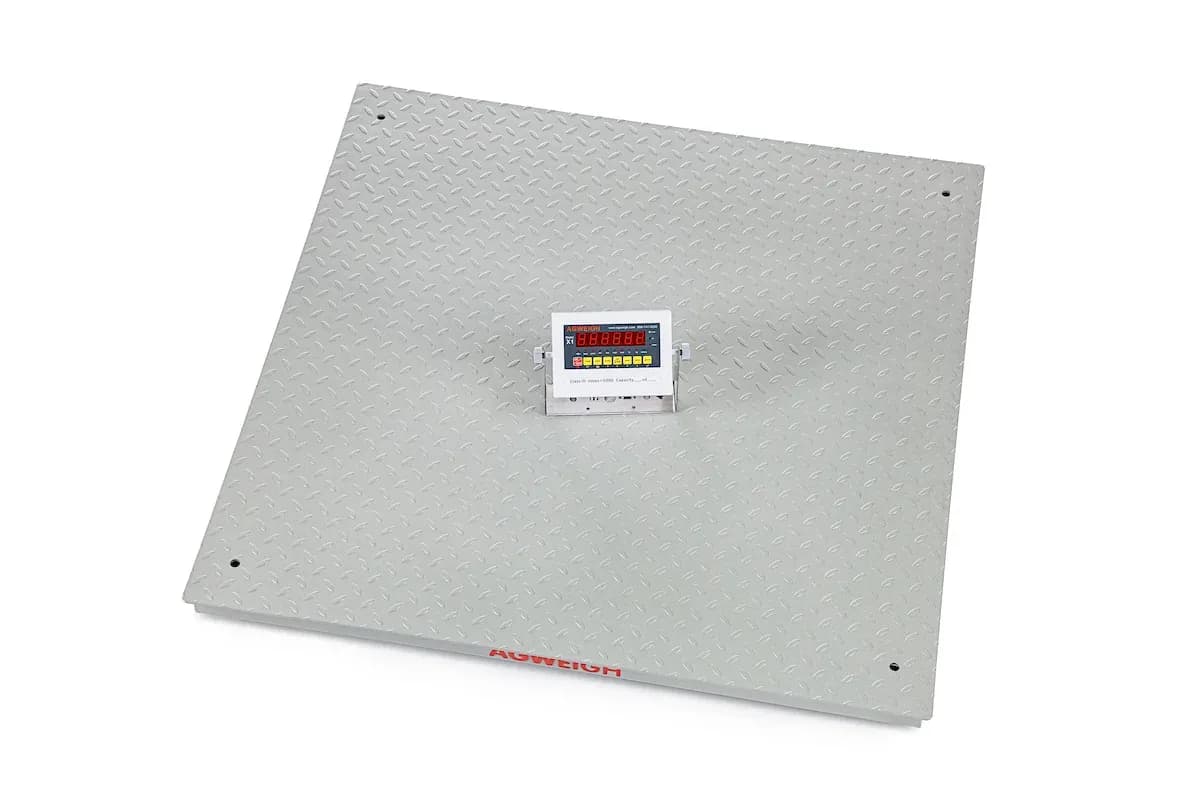
The environment in which your scale operates dictates the material you must choose. Mild steel scales, often finished with a durable powder coat or a diamond-plate safety tread, are the workhorses of dry industrial environments. They offer exceptional structural strength and value for warehouses, shipping departments, and scrap recycling facilities. For example, a heavy-duty steel deck like the AG 4x4 NTEP Floor Scale delivers long-lasting accuracy in environments where moisture and corrosive chemicals are not a daily concern.
On the other hand, if your scale will be exposed to water, brine, acids, or frequent chemical sanitization, stainless steel is non-negotiable. In the food processing, pharmaceutical, and chemical industries, hygiene and corrosion resistance are paramount. Stainless steel scales (typically constructed from high-grade 304 or 316 stainless steel) prevent rust and bacterial buildup.
Furthermore, high-end washdown scales often feature advanced mechanical designs, such as gas-shock assisted lift mechanisms, allowing operators to lift the top deck easily for thorough cleaning underneath to meet strict sanitary standards.
Understanding NTEP Certification and Legal-for-Trade Approvals
If you are purchasing a floor scale to buy or sell goods based on weight, you must understand NTEP certification. NTEP stands for the National Type Evaluation Program, which is administered by the National Conference on Weights and Measures (NCWM).
An NTEP certificate of conformance indicates that a scale design has undergone rigorous testing to ensure it meets strict legal standards for accuracy and reliability. For commercial shipping, freight forwarding, recycling buy-back centers, and retail packaging, using a certified Class III scale is a legal requirement. You can read more about these regulatory standards and certified equipment on the Legal for Trade Scales page.

Why Legal-for-Trade Matters for Floor Scales Online
When you conduct commercial transactions where the price of a transaction is determined by the weight reading on a scale, that scale must be "legal-for-trade." If a business uses a non-certified scale for commercial transactions, they risk severe fines from local weights and measures officials, not to mention potential disputes with customers over inaccurate billing.
When searching for floor scales online, always verify whether the scale base, load cells, and digital weight indicator are NTEP approved. For instance, the AG 4x4 NTEP Floor Scale features Class III approval, ensuring that your commercial shipping or recycling operation remains fully compliant with state and federal laws.
Overload Protection and Load Cell Accuracy
Even if you do not strictly require a legal-for-trade scale for internal inventory tracking, choosing an NTEP-approved scale is still a smart move. Why? Because the certification process guarantees a high standard of build quality.
NTEP-certified scales utilize high-quality shear beam load cells (often four matched cells positioned in the corners of the scale) that provide consistent accuracy regardless of where the load is placed on the platform.
Furthermore, industrial-grade scales are engineered with structural overload protection. Many top-tier models offer up to 200% overload protection, meaning the physical frame can support twice its rated capacity without damaging the sensitive load cells underneath. This shock absorption is critical when heavy pallets are dropped onto the scale by hurried forklift operators.
Essential Features and Accessories for Industrial Applications
A complete industrial weighing system consists of more than just a metal platform. To get the most out of your purchase, you must consider the digital weight indicator, internal components, and physical accessories that streamline your workflow. You can explore a wide variety of these industrial systems and their configurations in the Industrial Scales Overview.
Ramps, Printers, and Pit Frames
Depending on how you move materials through your facility, several key accessories can dramatically improve efficiency and safety:
- Access Ramps: If your warehouse utilizes manual pallet jacks instead of forklifts, ramps are an absolute necessity. They allow operators to roll heavy pallets directly onto the scale platform smoothly.
- Pit Frames: For facilities looking to maximize floor space and minimize trip hazards, pit frames allow the scale to be installed flush with the surrounding concrete floor. This design allows forklifts and pallet jacks to drive over the scale from any direction.
- Ticket Printers: For immediate record-keeping and traceability, connecting a thermal ticket printer to your scale indicator allows operators to print weight receipts on the spot, complete with time, date, and part counts.
- Bumper Guards: Heavy steel guards anchored to the floor around the perimeter of the scale protect the sensitive platform from accidental side impacts from heavy forklifts.
Comparing Bench Scales vs. Floor Scales Online
Not every weighing task requires a massive floor platform. If your facility processes smaller boxes, food portions, or individual parts, a bench scale may be a more appropriate and cost-effective choice.
Unlike floor scales, bench scales are designed to sit on worktables or counters, offering highly precise measurements for lighter capacities. You can compare different options by looking through the Bench Scales selection, or check out specific heavy-duty units like the XB Bench Scale.
For businesses that package products for retail sale, integrating specialized Retail Scales ensures precise portion control and pricing accuracy. If you are looking for a light-duty, commercial-grade platform scale for lighter food or shipping applications, you might also consider retail-oriented options like the 660lbs Weight LED Computing Digital Scale Floor Platform Scale, 0.1 lbs. Accuracy Computing Floor Food Scale, Black for entry-level, non-industrial tasks.
Best Practices for Purchasing, Installing, and Maintaining Floor Scales
Buying a floor scale online is highly convenient, but the work doesn't stop once you click "place order." To ensure long-term accuracy, safety, and compliance, buyers should follow several key installation and maintenance steps.
First, proper leveling is crucial. Most industrial floor scales feature adjustable leveling feet. Because warehouse floors are rarely perfectly flat, you must use a bubble level and adjust each foot from the top access points on the deck until the scale is completely level. An unlevel scale will distribute weight unevenly across the four load cells, leading to inaccurate readings.

Second, regular calibration is the only way to guarantee that your scale remains accurate over time. Environmental changes, heavy impacts, and general wear and tear will cause any scale to drift. Utilizing professional Scale Calibration Services on a semi-annual or annual basis keeps your equipment operating within tolerance.
For large-scale operations, utilizing professional Onsite Services ensures that certified technicians can perform heavy-capacity calibration and preventative maintenance directly at your facility, minimizing operational downtime.
Frequently Asked Questions About Industrial Floor Scales
What is the difference between NTEP and non-NTEP floor scales?
NTEP-certified scales have been officially evaluated and approved for "legal-for-trade" applications, meaning they can be legally used to buy, sell, or charge tariffs based on weight. Non-NTEP scales are designed for internal inventory tracking, quality control, or checkweighing where commercial transactions are not taking place.
How often should an industrial floor scale be calibrated?
For most standard warehouse applications, calibration should be performed at least once or twice a year. However, if your scale is subjected to high-volume usage, harsh environmental conditions, or frequent heavy impacts, you may need to calibrate it quarterly to maintain strict accuracy.
Can floor scales be installed in a pit for flush-mount access?
Yes. By utilizing a specialized pit frame, you can install a standard floor scale flush with your concrete floor. This setup is highly recommended for facilities that want to allow smooth forklift traffic and pallet jack access across the weighing area without the need for external ramps.
Conclusion
Investing in industrial weighing equipment is a significant decision for any business. By understanding the differences in platform materials, weight capacities, and legal certifications, you can confidently navigate the process of sourcing floor scales online.
With nearly 60 years of industry experience, global service support, and a comprehensive lineup of NTEP-certified legal-for-trade products, Walz Scale is dedicated to delivering rugged, highly accurate weighing solutions built to survive the toughest environments. Explore the full range of heavy-duty Industrial Floor & Pallet Scales today to find the perfect fit for your operation.