
Why Portable Train Weighing Systems Are Replacing Fixed Weighbridges
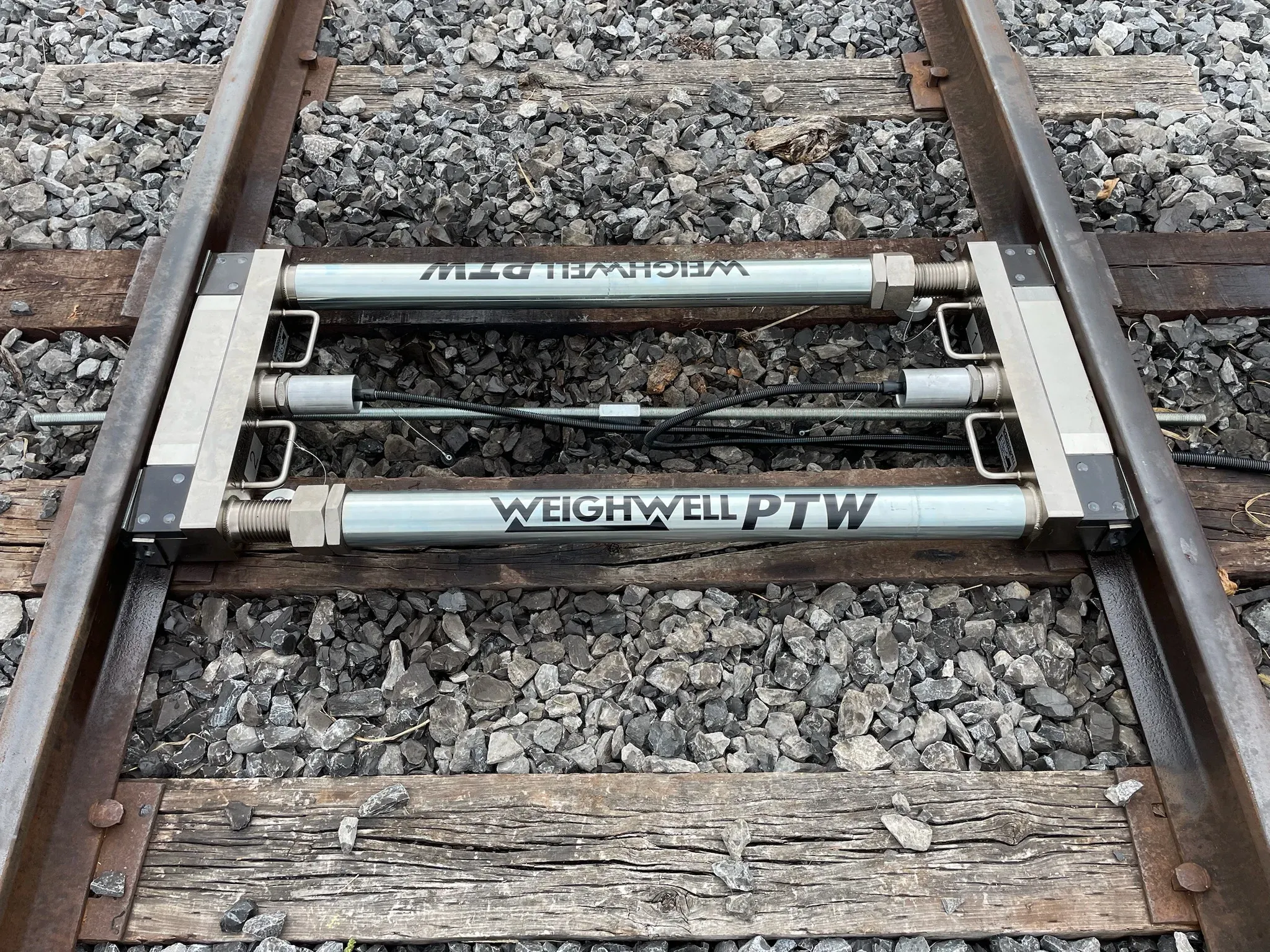
Portable train weighing systems are self-contained, load-cell-based scales that clip directly onto existing rails — no pit, no concrete, no track modification required. A two-person team can set one up in 10 to 15 minutes and move it to a completely different location the same day.
Here's a quick overview of what these systems offer:
| Feature | Portable Rail Scale |
|---|---|
| Setup time | 10-15 minutes (two-person team) |
| Static accuracy | ±0.5% under good track conditions |
| In-motion accuracy | 2-3% (under 1% in ideal conditions) |
| Max axle capacity | Up to 35t per axle / 17.5t per wheel |
| Civil works required | None |
| Rail gauge compatibility | All standard gauges |
| Power options | AC mains or internal battery |
| Data export | USB, CSV, wireless, print |
If you manage rail operations in mining, agriculture, freight, or heavy industry, the case for portable weighing is straightforward: accurate weight data, anywhere on your network, without shutting down track or pouring concrete.
Traditional fixed weighbridges work well for high-volume permanent locations. But they're expensive to install, tied to a single point on the network, and require significant civil works. For operations that need flexibility — spot checks, maintenance depots, remote sidings, or short-term projects — a portable system is simply the more practical tool.
The sections below cover how these systems work, what to look for when choosing one, and how they connect to broader data and compliance workflows.
What Are Portable Rail Scales vs. Fixed Rail Scales?
To understand why portable train weighing systems are a game-changer for modern rail logistics and maintenance, it helps to look at the limitations of traditional infrastructure.
For decades, the standard method for weighing rolling stock was the permanent fixed rail scale. These are massive, pit-type structures built directly into a dedicated section of the track. Installing one is a major engineering project. It requires excavation, pouring heavy concrete foundations, and cutting the rail line to insert the scale mechanism. This process can take weeks of construction, resulting in significant track downtime and high capital expenditures.
While fixed scales are incredibly robust and ideal for high-throughput, legal-for-trade commercial hubs, they lack one critical feature: flexibility. Once poured, a fixed scale cannot be moved. If your weighing needs shift to a different siding, a remote mining site, or a temporary agricultural co-op, you must reroute your entire fleet to that single point of measurement.
In contrast, portable rail scales are designed to bring the scale to the train, rather than the train to the scale. Instead of modifying the track, these systems use low-profile, modular weighing units that fit directly between the rail fastenings of virtually any standard rail profile.
They work by using precision load cells to slightly elevate the wheel flange just above the rail head. This ensures that the entire weight of the wheel is applied directly to the scale, bypassing any imperfections on the running surface of the rail. Because they require zero civil works, no rail cutting, and no welding, you can deploy them on active lines without permanently altering the track infrastructure.
Static vs. Dynamic Portable Train Weighing Systems
Portable rail scales are generally categorized into two primary operating modes: static and dynamic (in-motion). Choosing between them depends on whether your priority is extreme precision or operational speed.
- Static Weighing Systems: In static mode, the train must come to a complete stop with its wheels positioned directly on the weighing units. This method is highly precise, typically achieving accuracy levels of ±0.5% or better under ideal track conditions. Static systems are the preferred choice for detailed maintenance inspections, wheel-load balancing, and verifying center-of-gravity distribution after rolling stock repairs.
- Dynamic (In-Motion) Weighing Systems: Rail in-motion weighing systems allow trains to be weighed as they move slowly over the scale, typically at speeds up to 3 to 5 mph (5 km/h). As each axle passes over the low-profile weighing pads, the system instantly records the wheel and axle weights. This allows operators to weigh an entire train coupled-in-motion without stopping, dramatically speeding up throughput in busy freight terminals and bulk material yards.
Key Benefits of Portable Rail Scales
Implementing a portable weighing solution offers massive operational advantages that directly impact safety, compliance, and your bottom line.

- Derailment Prevention: Unevenly loaded railcars are a primary cause of derailments. If a wagon is heavily side-loaded or has an unbalanced cross-axle weight distribution, the wheel flange can climb the railhead on tight curves. Portable scales allow operators to quickly verify side-to-side and end-to-end weight distribution, catching dangerous imbalances before the train leaves the yard.
- Overload Protection: Overloading damages not only the railcars themselves—putting excessive wear on wheel profiles, bearings, axle boxes, and suspension systems—but also the track infrastructure. Portable systems allow for rapid spot-checks at loading sites to ensure all wagons remain within safe engineering and regulatory limits.
- Inventory Control and Yield Management: In industries like mining, agriculture, and recycling, knowing the exact weight of bulk materials loaded onto each train is critical for billing and process control. Portable scales provide immediate payload verification right at the loading point, preventing under-loading (which wastes fuel and shipping capacity) and over-loading (which leads to costly fines).
- Optimized Maintenance: For maintenance depots and workshops, portable scales are essential for wheel-load balancing. After replacing bogies, wheelsets, or springs, technicians can use the scale to verify that the locomotive or carriage is perfectly balanced, ensuring stable track dynamics and extending the lifespan of expensive rolling stock components.
To explore how different rail scale designs stack up against each other for specific industrial applications, you can read our detailed rail comparisons guide.
Rapid Deployment and Minimal Track Downtime
The most compelling operational benefit of a portable train scale is how quickly it can be deployed. A standard system can be unpacked, installed, and calibrated in just 10 to 15 minutes by a two-person team.
The setup process requires no specialized heavy machinery. The weighing units are lightweight enough to be transported in the trunk of a utility vehicle or a train cabin. Technicians simply clear minor debris from the rail seat, place the scale units between the existing rail fastenings, secure them with integrated support bars, and connect the cabling to a portable weight indicator. Because the process is entirely non-invasive, the track can return to normal line-speed traffic the moment the scale units are lifted back off the rails.
Cost-Effective Operations and Rental Flexibility
For many operations, purchasing a permanent rail scale is hard to justify financially, especially for short-term contracts, seasonal agricultural harvest peaks, or temporary construction projects.
This is where the financial flexibility of portable systems shines. Because they require zero concrete foundations or track modifications, the upfront capital expenditure is a fraction of a fixed weighbridge. Furthermore, operators can take advantage of portable rail scales rental options to scale their weighing capabilities up or down based on seasonal demand, avoiding long-term maintenance costs and capital depreciation.
Choosing the Right Portable Train Weighing Systems
When evaluating portable train weighing systems for your operation, several technical specifications and environmental factors must be considered to ensure reliable, long-term performance.

Technical Specifications to Consider
- Axle and Wheel Capacity: Ensure the scale can handle your heaviest rolling stock. Premium portable systems are designed to support heavy-duty industrial loads, offering capacities up to 35 tons per axle (17.5 tons per wheel).
- Environmental Protection: Rail environments are notoriously harsh, exposing equipment to rain, mud, snow, and extreme temperatures. Look for scale units with an IP67 protection rating, meaning they are fully sealed against dust and water immersion.
- Operating Temperature Range: The system should operate reliably in extreme climates. High-quality systems are rated to perform flawlessly in temperatures ranging from -40°C up to +80°C (-40°F to +176°F).
- Power and Connectivity: For remote or off-grid locations, look for systems equipped with long-lasting internal rechargeable batteries (offering at least 10 hours of active use) and wireless data transmission options to eliminate tripping hazards from cabling.
| Specification | Static Mode | Dynamic (In-Motion) Mode |
|---|---|---|
| Typical Accuracy | ±0.1% to ±0.5% | ±2.0% to ±3.0% (under 1% in ideal conditions) |
| Weighing Speed | Stopped on scale | Up to 3-5 mph (5 km/h) |
| Best Use Case | Wheel balancing, maintenance, high-precision checks | High-throughput logistics, bulk freight yards |
| Typical Increment | 10 kg / 20 lbs | 20 kg to 50 kg / 50 lbs to 100 lbs |
Factors Affecting Accuracy in Portable Train Weighing Systems
While portable scales are highly accurate, their real-world performance is heavily influenced by the installation environment:
- Track Conditions: The track section where the scale is placed must be straight, level, and well-compacted. Any vertical slope or lateral curve in the track will cause weight to shift from one side of the train to the other, skewing the measurements.
- Train Speed Consistency: For dynamic, in-motion weighing, the train must maintain a slow, steady speed (typically under 3 mph) as it crosses the scale. Sudden braking or acceleration causes weight transfer between coupled railcars, which reduces accuracy.
- Rail Profile and Alignment: The scale must be compatible with your specific rail profile (e.g., 115 RE, 136 RE, etc.). Utilizing precision-engineered rail shoes ensures a snug fit and prevents the scale from shifting under load.
- Calibration Standards: To maintain reliable measurements, portable scales should be periodically calibrated using equipment traceable to international standards, such as OIML R106 for dynamic weighing or OIML R60 for load cells.
Advanced Data Integration and Volumetric Scanning
Modern rail logistics relies on data. Portable rail scales should do more than just display a number on a screen; they must integrate seamlessly with your broader digital workflow.
Advanced portable weighing systems connect to intuitive software suites that compile wheel, axle, bogie, and total train weights in real-time. This data can be instantly printed as a weight ticket, saved to a local USB drive as a CSV file, or transmitted wirelessly to your company's central ERP system.
For operations looking to maximize loading efficiency, combining weight data with volumetric scanning is the ultimate solution. By deploying a railcar load volume scanning system alongside your portable scale, you can capture both the weight and the physical volume of the material inside the car.
This combined approach is incredibly valuable for bulk materials like coal, woodchips, and aggregate. It allows operators to detect under-loading or uneven distribution of material inside the railcar body, even if the total weight is within limits.
To see this technology in action, you can read the CertainTeed rail scanner case study, which highlights how industrial operations use WLS rail volumetric load scanners to optimize payload distribution, or explore our rail WIM monitoring system for continuous, high-speed tracking.
Frequently Asked Questions About Rail Scales
How accurate are portable rail scales?
When installed on level, well-supported track, portable rail scales achieve impressive accuracy. In static weighing mode, they typically deliver an accuracy of ±0.5% or better. For dynamic (in-motion) weighing, the typical error rate is 2% to 3%, though this can improve to under 1% under ideal track conditions and consistent train speeds.
Can portable rail scales be used on any track gauge?
Yes. Because portable weighing units are modular and sit directly on the inside of the rail web, they are independent of the overall track width. They can be adjusted to fit standard gauge, narrow gauge, or broad gauge tracks. You only need to ensure that the scale's rail shoes match the specific rail profile (such as 115 RE or 136 RE) of the track you are using.
How long does it take to install a portable rail scale?
A standard portable rail scale can be fully installed and ready to operate in 10 to 15 minutes by a two-person team. No excavation, rail cutting, or specialized heavy tools are required. Removal is just as fast, allowing the track to be cleared for normal high-speed traffic immediately.
Conclusion
As rail networks face increasing pressure to improve safety, boost throughput, and control operational costs, the flexibility of weighing infrastructure has never been more important. Portable train weighing systems provide a highly accurate, cost-effective, and rapidly deployable alternative to traditional fixed weighbridges, allowing you to capture critical wheel and axle weight data wherever your operations require it.
Whether you are looking to rent a system for a temporary project or integrate a permanent in-motion monitoring solution with volumetric scanning, Walz Scale has provided heavy-duty, field-proven weighing systems to industrial operators worldwide for nearly 60 years.
Ready to optimize your rail operations? Request a Quote today to find the perfect weighing configuration for your site, or visit the Walz Scale homepage to browse our full lineup of industrial weighing solutions.